
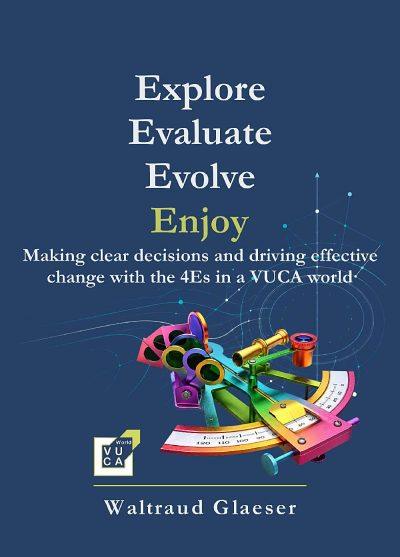
The 4Es – Explore · Evaluate · Evolve · Enjoy – offer a practical framework for navigating complexity and shaping change in organisations, in leadership and in our own professional lives.
Explore helps us understand what is really happening.
Evaluate enables us to put developments into context, recognise connections and identify where we can make a difference.
Evolve turns insight into clear decisions and purposeful action.
Enjoy adds something that is often underestimated: the energy, confidence and sense of possibility we need to shape the future rather than merely respond to it.
This book is written for decision-makers, people in leadership roles, consultants, coaches and anyone who wants to do more than simply cope with change.
Details
Publication date: End October 2026
Number of pages of the paperback: 425
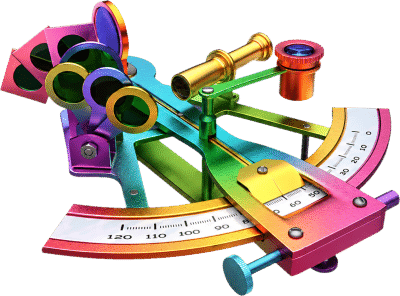
A Sextant as a Metaphor for the 4Es
A sextant does not move a ship. It does not make decisions for the crew. And yet, for centuries, it was one of the most important instruments in navigation. At sea, it made it possible to determine your position by precisely relating the horizon, celestial bodies and your own location to one another.
For me, this offers a powerful parallel to the 4Es:
Explore, Evaluate, Evolve, Enjoy
Today, companies, organisations and people often find themselves navigating open waters. Visibility changes. Familiar points of reference become blurred. In situations like these, what is needed first is a moment of careful observation.
The first V, Explore, is like looking through the sextant. What can actually be seen? What connections can be identified? Understanding means resisting the temptation to interpret too quickly and instead paying close attention to what is really there.
The second V, Evaluate, is the actual moment of navigation.
Observation becomes a determination of position. Where are we within this system? What does the current situation mean for us, for our organisation and for our responsibilities? Only by locating ourselves does insight become relevant in practical terms.
The third V, Evolve, follows from this. Once we know where we are, we can review our course, correct it or set a new one. Change does not arise from action for action’s sake. It comes from purposeful action based on understanding and locating.
The fourth V, Enjoy, reminds us that navigation is not only about effort. Those who navigate difficult waters together need confidence, energy and a sense of joy in making progress. This includes recognising progress, making shared capabilities visible and taking the human side of change seriously.
A sextant does not show the entire route ahead. It helps us determine our own position in relation to the world around us. This is how I understand the 4Vs: as a logic for navigating a complex environment. They do not promise simple answers. But they help us see more clearly, locate ourselves more consciously, act more decisively and avoid leaving success to chance.
The book features guest perspectives from experts in business, the military, academia, elite sport, healthcare and entrepreneurship.








The Author
Waltraud Gläser
Expert on the challenges of the modern world of work
“I know my craft!”
“The future needs a past.”
A phrase I used for many years, but one I increasingly find myself questioning.
Because if we follow that logic, would it mean that “the future preserves the past”? Clearly not.
In a VUCA world, simply carrying forward established ways of thinking and familiar habits can become a risky trap.
Future readiness does not come from passively enduring change. It requires determination, conscious choices and the willingness to actively shape what comes next, even though uncertainty can never be eliminated entirely.